The kidneys play an important role in filtering waste and maintaining the body’s internal balance. Laboratory testing can help healthcare professionals assess kidney function and monitor changes over time.
A Renal Function Test (RFT), also called a Kidney Function Test, is a group of laboratory investigations used to evaluate important kidney-related markers.
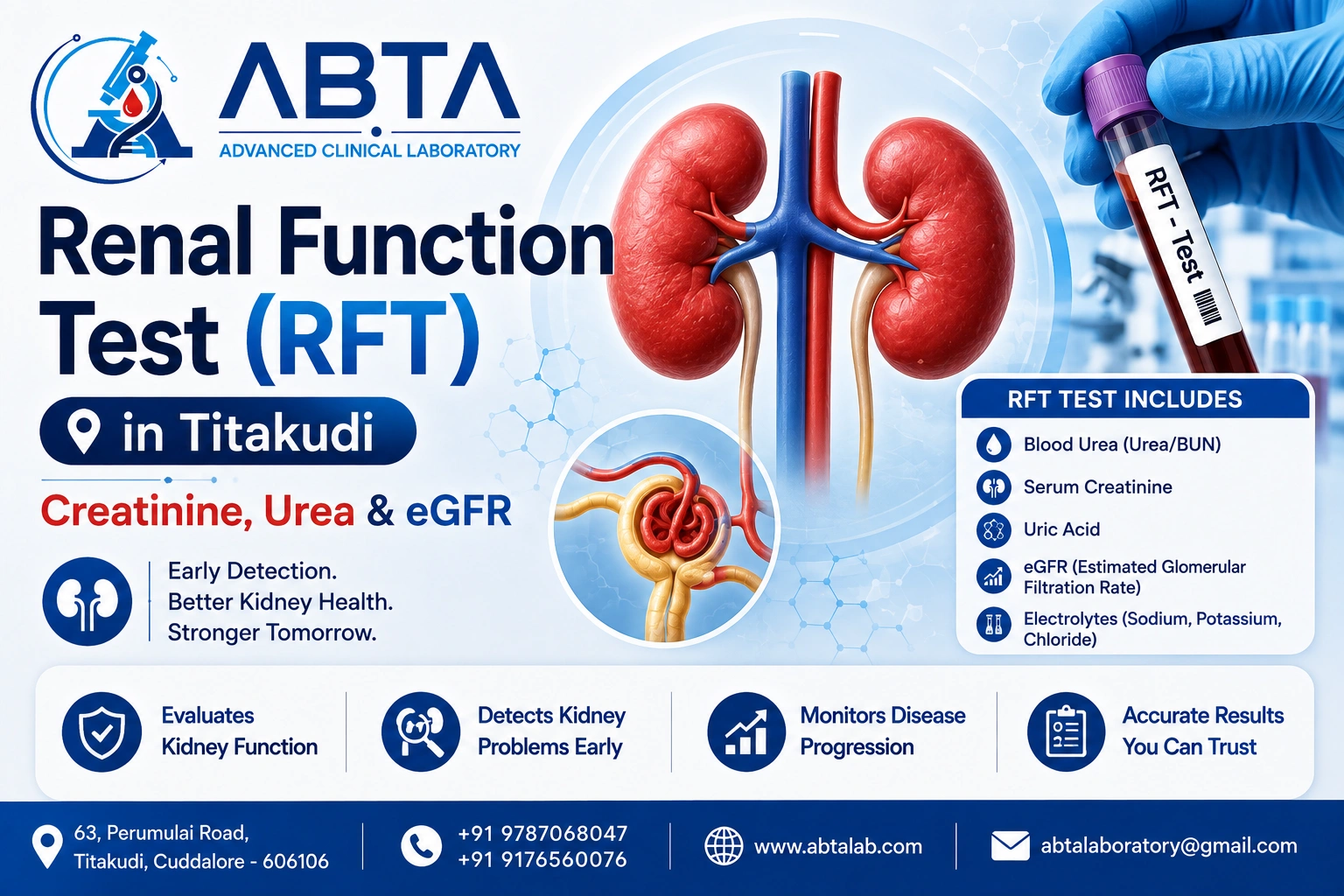
At ABTA Advanced Clinical Laboratory, Titakudi, the listed RFT includes blood urea, blood urea nitrogen (BUN), serum creatinine, uric acid and eGFR.
What Is a Renal Function Test?
A Renal Function Test is a set of blood investigations used to assess markers associated with kidney function.
The RFT panel listed by ABTA includes:
- Blood Urea
- Blood Urea Nitrogen (BUN)
- Serum Creatinine
- Uric Acid
- eGFR
These measurements can provide useful information to healthcare professionals when evaluating kidney health.
Why Is Kidney Function Testing Important?
Kidney-related conditions may not always cause obvious symptoms during their early stages. Laboratory investigations can therefore play an important role in identifying changes that require further medical evaluation.
Healthcare professionals may recommend kidney function testing as part of:
- Routine health checkups
- Preventive health assessments
- Monitoring existing medical conditions
- Evaluation of abnormal laboratory findings
- Monitoring kidney function during certain treatments
NIDDK notes that laboratory measurements such as GFR and urine albumin are important in the detection and management of chronic kidney disease.
Understanding the RFT Components
Blood Urea and BUN
Urea is a waste product measured in blood.
Blood Urea Nitrogen, or BUN, represents the amount of nitrogen in the blood that comes from urea.
Both are included in the RFT listed by ABTA.
Serum Creatinine
Creatinine is produced as part of normal muscle metabolism and is removed from the blood by the kidneys.
Healthcare professionals commonly use serum creatinine as part of the assessment of kidney filtration. NIDDK explains that creatinine measurements are used to estimate GFR.
Uric Acid
Uric acid is another biochemical marker included in ABTA’s renal function profile.
Its interpretation depends on the patient’s clinical situation and other laboratory findings.
eGFR
eGFR stands for estimated Glomerular Filtration Rate.
It provides an estimate of how well the kidneys filter blood. NIDDK describes eGFR as an estimate rather than a precise direct measurement of kidney function.
A healthcare professional may look at eGFR values over time rather than relying on one isolated result.
Why Is eGFR Important?
eGFR is particularly useful because it provides an estimated measure of kidney filtration.
NIDDK notes that trends in eGFR can be more informative than a single value when assessing changes in kidney function.
This means that patients should avoid interpreting an eGFR result without considering their age, medical history, other laboratory results and previous test values.
RFT and Other Kidney-Related Tests
Depending on the clinical situation, healthcare professionals may request additional investigations.
For example, NIDDK highlights urine albumin testing as another important component when evaluating kidney disease risk.
Therefore, the exact tests required may differ from person to person.
Does RFT Require Fasting?
Whether fasting is required depends on the complete set of tests ordered.
If an RFT is being performed along with glucose, lipid or other investigations, the preparation instructions may be different.
Always confirm preparation requirements with your healthcare provider or laboratory before giving the sample.
RFT Test in Titakudi
Patients searching for a Renal Function Test in Titakudi, Kidney Function Test in Titakudi, or Diagnostic Centre in Titakudi can consider ABTA Advanced Clinical Laboratory for the listed RFT investigations.
ABTA’s laboratory service information identifies RFT under its biochemistry investigations.
ABTA Advanced Clinical Laboratory
63, Perumulai Road,
Titakudi, Cuddalore – 606106
For current test availability, preparation instructions and report-related information, contact the laboratory directly.
Final Thoughts
Kidney function testing provides important laboratory information about markers such as urea, creatinine and eGFR.
The RFT panel at ABTA includes blood urea/BUN, serum creatinine, uric acid and eGFR.
If your healthcare professional has recommended an RFT, completing the investigation and discussing the results with your doctor can help put the numbers into the correct clinical context.
Medical Disclaimer: This article is for educational purposes only. A laboratory result alone cannot diagnose a medical condition. Always consult a qualified healthcare professional for interpretation and treatment decisions.