Thyroid Profile Test: TSH, Free T3, Free T4 and Total T3/T4 Explained
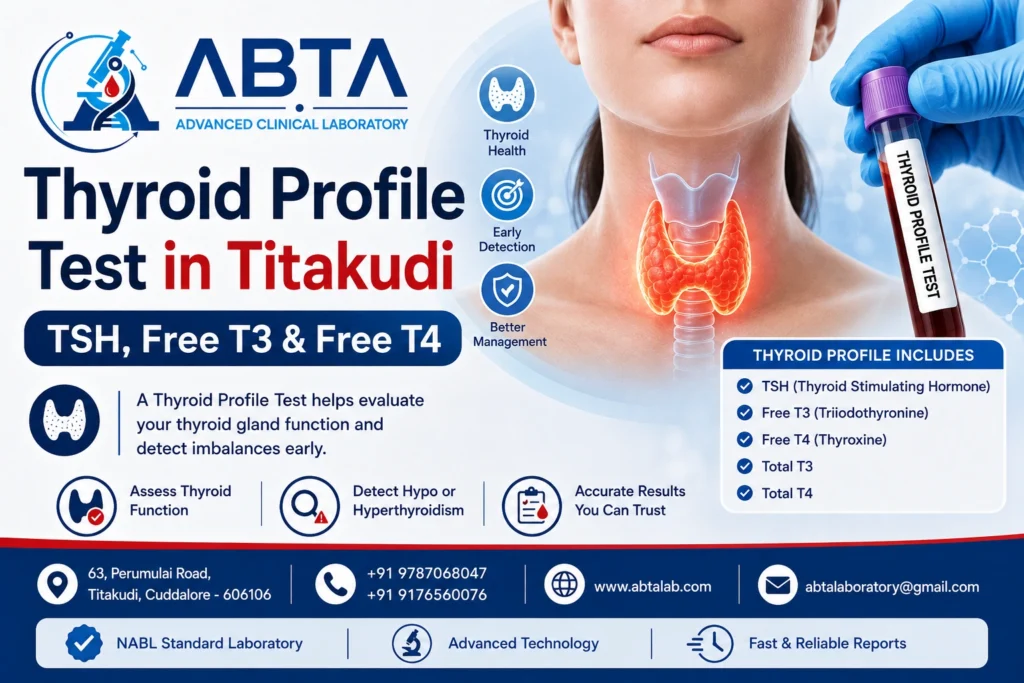
The thyroid is a small gland that produces hormones involved in regulating many important body functions. When thyroid hormone levels are too high or too low, healthcare professionals may recommend blood tests to evaluate thyroid function. A Thyroid Profile is a group of laboratory tests that can include measurements such as TSH, Free T4, Free T3, Total T4 and Total T3. ABTA Advanced Clinical Laboratory in Titakudi lists all five of these investigations as part of its thyroid profile. What Is a Thyroid Profile? A thyroid profile is a combination of blood tests used to assess thyroid hormone status. The thyroid profile listed by ABTA includes: The exact combination of tests needed can depend on the clinical situation. What Is a TSH Test? TSH stands for Thyroid Stimulating Hormone. TSH is produced by the pituitary gland and signals the thyroid gland to produce thyroid hormones. MedlinePlus describes TSH as a commonly used thyroid blood test and notes that it is often the first thyroid test ordered when evaluating thyroid function. A TSH result that is higher or lower than expected can indicate that further thyroid evaluation may be needed, but TSH alone does not necessarily identify the cause of an abnormal thyroid result. What Is Free T4? T4, or thyroxine, is a hormone produced by the thyroid gland. Free T4 (FT4) measures the unbound form of T4 in the blood. MedlinePlus notes that Free T4 is commonly used with other thyroid tests to evaluate and monitor thyroid disorders. What Is Free T3? T3 is another thyroid hormone. Free T3 (FT3) measures the free form of this hormone. Depending on the patient’s symptoms and laboratory findings, a healthcare professional may request T3 along with TSH and T4 testing. What Are Total T3 and Total T4? Unlike Free T3 and Free T4, total hormone measurements include hormone that is both free and bound to proteins in the blood. ABTA’s thyroid profile includes both free and total forms: The appropriate tests depend on the clinical question being investigated. Why Is Thyroid Testing Done? Healthcare professionals may recommend thyroid testing when evaluating possible thyroid dysfunction. Thyroid blood tests may be used to help evaluate conditions such as: MedlinePlus notes that thyroid testing can help evaluate whether the thyroid is functioning normally and can assist in the evaluation of hyperthyroidism and hypothyroidism. Symptoms That May Lead to Thyroid Testing Symptoms associated with thyroid disorders can vary considerably. Depending on the condition, a person may experience changes involving: However, these symptoms can have many different causes. A thyroid blood test should therefore be interpreted in the context of a person’s complete clinical evaluation. Does a Thyroid Test Require Fasting? A TSH test itself generally does not require special preparation. However, preparation requirements may differ when multiple blood tests are ordered at the same appointment. Certain medicines and supplements can also affect thyroid test results. Patients should inform their healthcare professional about medicines and supplements they are taking and should not stop prescribed medicines unless instructed to do so. Why Is It Important to Test the Right Combination? No single thyroid test provides every piece of information in every situation. For example, TSH is commonly used as an initial thyroid test, while Free T4, T3 and other measurements may be added depending on the clinical question. MedlinePlus notes that abnormal TSH results may lead to additional thyroid blood tests such as T4 or T3. Thyroid Profile Test in Titakudi If you are looking for a Thyroid Profile Test in Titakudi, TSH Test in Titakudi, Free T3 Test, or Free T4 Test, ABTA Advanced Clinical Laboratory lists thyroid profile testing among its biochemistry services. The laboratory’s listed thyroid profile includes: TSH + Free T4 + Free T3 + Total T4 + Total T3. ABTA Advanced Clinical Laboratory63, Perumulai Road,Titakudi, Cuddalore – 606106 Patients should contact the laboratory for current availability and test preparation instructions. Thyroid Testing as Part of Preventive Health Laboratory testing can be one part of a broader health assessment. For people who have symptoms, an existing thyroid condition or a healthcare professional’s recommendation for monitoring, appropriate thyroid testing can provide useful laboratory information. The results should always be interpreted alongside symptoms, medical history and other relevant findings. Final Thoughts A thyroid profile can include several important blood tests, including TSH, Free T3, Free T4, Total T3 and Total T4. ABTA Advanced Clinical Laboratory, Titakudi, provides these listed thyroid investigations as part of its biochemistry laboratory services. If you have been advised to undergo thyroid testing, follow the laboratory’s instructions and discuss your results with a qualified healthcare professional. Medical Disclaimer: This article is intended for general educational information only and should not be used for self-diagnosis or treatment decisions.
Diabetes Tests in Titakudi: FBS, PPBS & HbA1c Explained
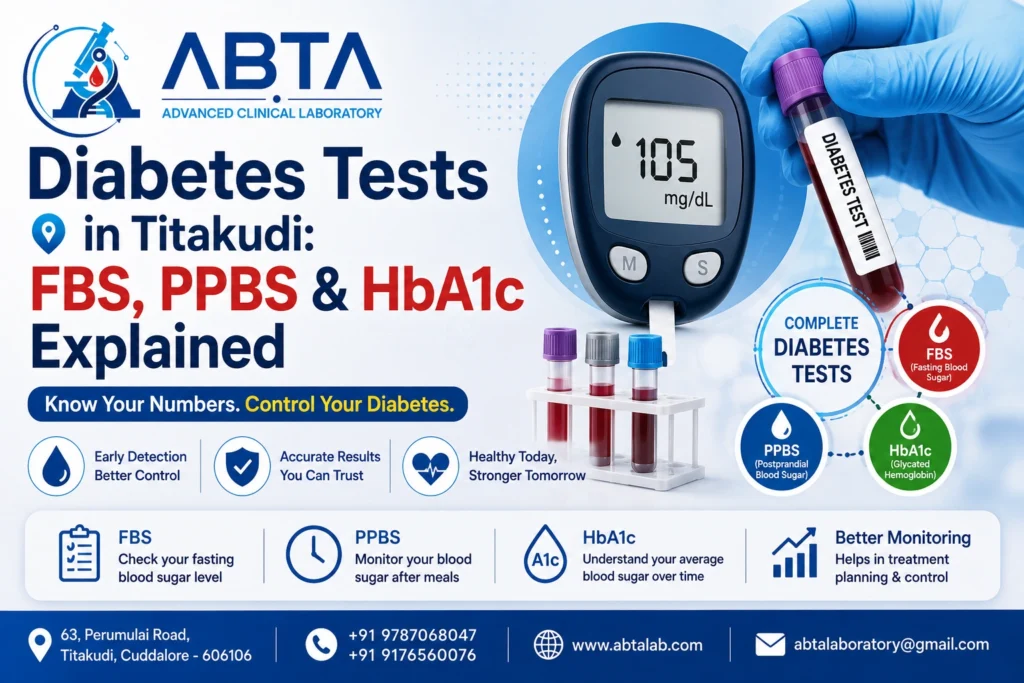
Blood glucose testing is an important part of diabetes screening, diagnosis and monitoring. However, different blood sugar tests provide different types of information. The diabetes profile listed by ABTA Advanced Clinical Laboratory, Titakudi includes: Understanding the purpose of these tests can help patients better understand why their healthcare professional may request more than one blood glucose investigation. What Is a Diabetes Profile? A diabetes profile is a combination of laboratory investigations used to evaluate blood glucose and related markers. Rather than depending on a single measurement, healthcare professionals may use different tests depending on whether they are screening for diabetes, evaluating symptoms or monitoring an existing diagnosis. What Is Fasting Blood Sugar? Fasting Blood Sugar (FBS) measures blood glucose after a period of fasting. It provides a measurement of blood glucose at a specific point in time. CDC information lists fasting blood sugar as one of the tests used for diabetes and prediabetes evaluation. Because fasting is important for this test, patients should follow the preparation instructions provided by the healthcare professional or laboratory. What Is PPBS? PPBS stands for Postprandial Blood Sugar. Unlike a fasting measurement, a postprandial blood sugar test evaluates blood glucose after eating. This provides a different view of glucose levels compared with fasting blood sugar. The timing of the sample in relation to the meal is important, so patients should follow the specific instructions given when the test is ordered. What Is HbA1c? HbA1c, also called A1C, is different from FBS and PPBS. Instead of measuring blood glucose at one particular moment, A1C provides an estimate of average blood glucose over approximately the previous two to three months. This makes HbA1c useful for both diabetes screening/diagnosis and monitoring in appropriate clinical situations. Does HbA1c Require Fasting? Generally, HbA1c does not require fasting. However, if your doctor has ordered other tests at the same appointment, those tests may require fasting. Therefore, always check the complete test package before eating or drinking. Understanding Common HbA1c Ranges For diabetes and prediabetes assessment, commonly used A1C ranges are: These values are used as diagnostic criteria in appropriate clinical settings, but diagnosis should be made by a healthcare professional and may require confirmation or additional testing. Why Can More Than One Diabetes Test Be Ordered? FBS, PPBS and HbA1c answer different questions. FBS Provides information about blood glucose after fasting. PPBS Provides information about blood glucose after a meal. HbA1c Provides an indication of average blood glucose over the previous two to three months. Because these tests measure different aspects of glucose control, a healthcare professional may choose one or several depending on the patient’s situation. What About Fasting Insulin? ABTA’s listed diabetic profile also includes fasting insulin. Insulin is a hormone involved in regulating blood glucose. A fasting insulin test may be requested in specific clinical situations and should be interpreted along with other findings. Diabetes Testing in Titakudi If you are searching for a Diabetes Test in Titakudi, HbA1c Test in Titakudi, Blood Sugar Test in Titakudi, or a Blood Testing Lab near you, ABTA Advanced Clinical Laboratory provides the listed diabetic profile investigations. The laboratory is located at: 63, Perumulai Road, Titakudi,Cuddalore – 606106 For test preparation, availability and reporting information, contact ABTA Clinical Laboratory directly. Why Regular Testing Can Matter Diabetes management is not based only on how a person feels on a particular day. Blood glucose changes over time, which is why laboratory testing can provide objective information for screening and monitoring. For people already diagnosed with diabetes, A1C is commonly used to monitor average blood glucose and assess how well the condition is being managed. Final Thoughts FBS, PPBS and HbA1c are not identical tests. FBS evaluates fasting glucose, PPBS evaluates glucose after eating, and HbA1c provides information about average blood glucose over the preceding two to three months. ABTA Advanced Clinical Laboratory lists all three among its diabetic profile investigations, along with fasting insulin. If your doctor has recommended diabetes testing, follow the preparation instructions carefully and discuss your results with your healthcare professional. Medical Disclaimer: This article is for general educational purposes and does not replace professional medical advice or diagnosis.
Renal Function Test (RFT) in Titakudi | Creatinine, Urea & eGFR
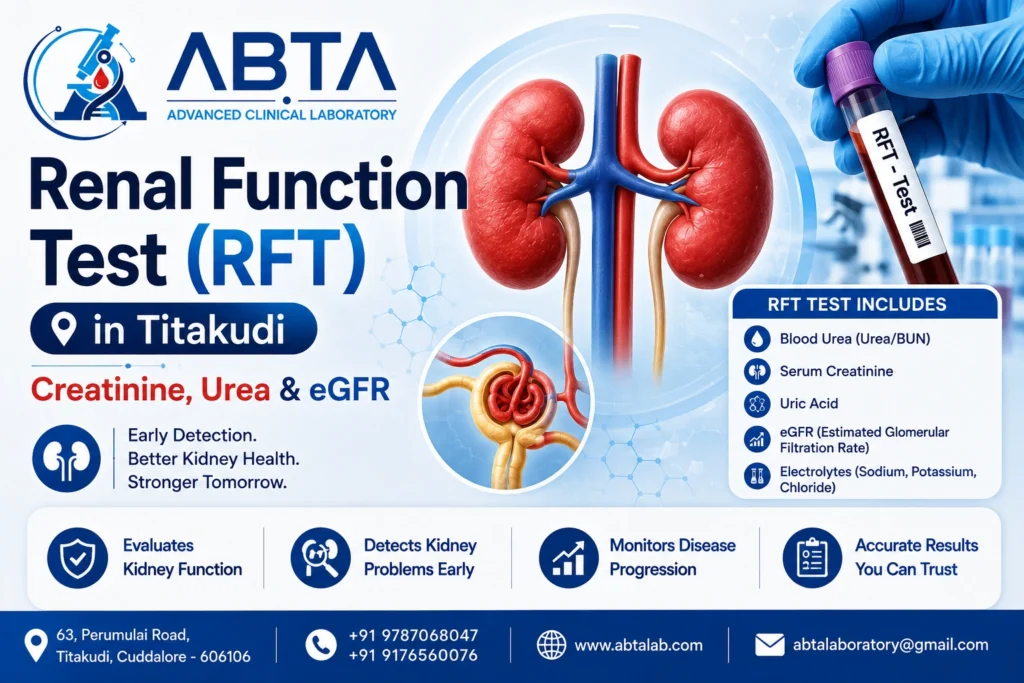
The kidneys play an important role in filtering waste and maintaining the body’s internal balance. Laboratory testing can help healthcare professionals assess kidney function and monitor changes over time. A Renal Function Test (RFT), also called a Kidney Function Test, is a group of laboratory investigations used to evaluate important kidney-related markers. At ABTA Advanced Clinical Laboratory, Titakudi, the listed RFT includes blood urea, blood urea nitrogen (BUN), serum creatinine, uric acid and eGFR. What Is a Renal Function Test? A Renal Function Test is a set of blood investigations used to assess markers associated with kidney function. The RFT panel listed by ABTA includes: These measurements can provide useful information to healthcare professionals when evaluating kidney health. Why Is Kidney Function Testing Important? Kidney-related conditions may not always cause obvious symptoms during their early stages. Laboratory investigations can therefore play an important role in identifying changes that require further medical evaluation. Healthcare professionals may recommend kidney function testing as part of: NIDDK notes that laboratory measurements such as GFR and urine albumin are important in the detection and management of chronic kidney disease. Understanding the RFT Components Blood Urea and BUN Urea is a waste product measured in blood. Blood Urea Nitrogen, or BUN, represents the amount of nitrogen in the blood that comes from urea. Both are included in the RFT listed by ABTA. Serum Creatinine Creatinine is produced as part of normal muscle metabolism and is removed from the blood by the kidneys. Healthcare professionals commonly use serum creatinine as part of the assessment of kidney filtration. NIDDK explains that creatinine measurements are used to estimate GFR. Uric Acid Uric acid is another biochemical marker included in ABTA’s renal function profile. Its interpretation depends on the patient’s clinical situation and other laboratory findings. eGFR eGFR stands for estimated Glomerular Filtration Rate. It provides an estimate of how well the kidneys filter blood. NIDDK describes eGFR as an estimate rather than a precise direct measurement of kidney function. A healthcare professional may look at eGFR values over time rather than relying on one isolated result. Why Is eGFR Important? eGFR is particularly useful because it provides an estimated measure of kidney filtration. NIDDK notes that trends in eGFR can be more informative than a single value when assessing changes in kidney function. This means that patients should avoid interpreting an eGFR result without considering their age, medical history, other laboratory results and previous test values. RFT and Other Kidney-Related Tests Depending on the clinical situation, healthcare professionals may request additional investigations. For example, NIDDK highlights urine albumin testing as another important component when evaluating kidney disease risk. Therefore, the exact tests required may differ from person to person. Does RFT Require Fasting? Whether fasting is required depends on the complete set of tests ordered. If an RFT is being performed along with glucose, lipid or other investigations, the preparation instructions may be different. Always confirm preparation requirements with your healthcare provider or laboratory before giving the sample. RFT Test in Titakudi Patients searching for a Renal Function Test in Titakudi, Kidney Function Test in Titakudi, or Diagnostic Centre in Titakudi can consider ABTA Advanced Clinical Laboratory for the listed RFT investigations. ABTA’s laboratory service information identifies RFT under its biochemistry investigations. ABTA Advanced Clinical Laboratory63, Perumulai Road,Titakudi, Cuddalore – 606106 For current test availability, preparation instructions and report-related information, contact the laboratory directly. Final Thoughts Kidney function testing provides important laboratory information about markers such as urea, creatinine and eGFR. The RFT panel at ABTA includes blood urea/BUN, serum creatinine, uric acid and eGFR. If your healthcare professional has recommended an RFT, completing the investigation and discussing the results with your doctor can help put the numbers into the correct clinical context. Medical Disclaimer: This article is for educational purposes only. A laboratory result alone cannot diagnose a medical condition. Always consult a qualified healthcare professional for interpretation and treatment decisions.
Liver Function Test (LFT) in Titakudi | Bilirubin, ALT, AST & More
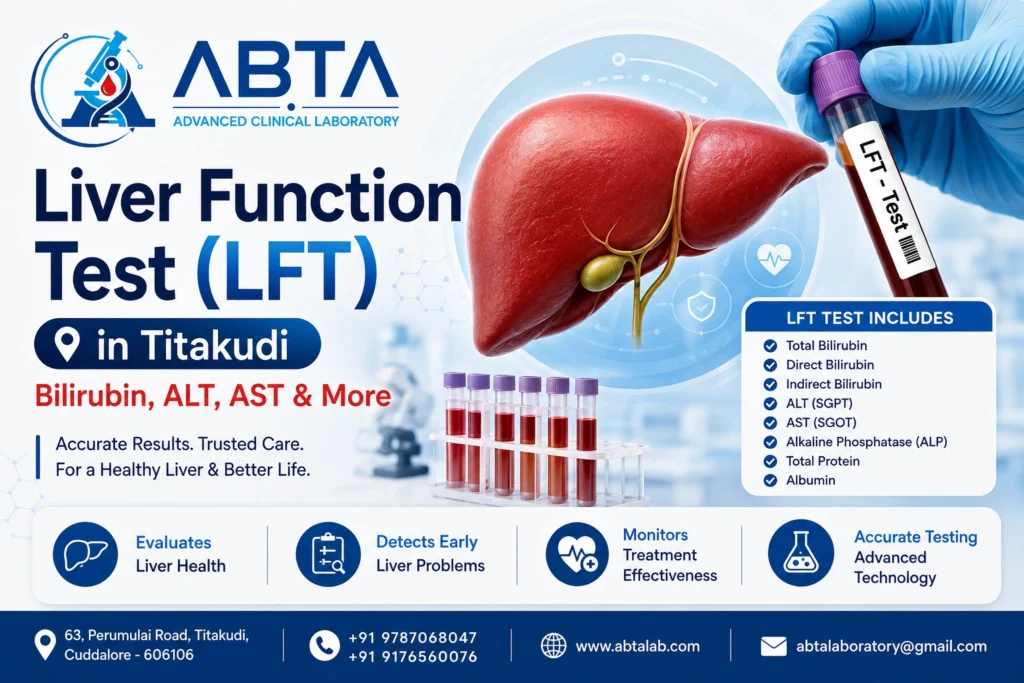
The liver performs many essential functions in the body, and laboratory testing can provide valuable information about liver-related health. A Liver Function Test (LFT) is not a single measurement but a group of blood tests used to assess different aspects of liver health and function. At ABTA Advanced Clinical Laboratory in Titakudi, the listed LFT panel includes bilirubin measurements, liver enzymes, total protein and albumin. What Is a Liver Function Test? A Liver Function Test is a group of blood investigations used to evaluate liver-related biochemical markers. The LFT services listed by ABTA include: MedlinePlus also lists bilirubin, albumin, ALP, ALT, AST and GGT among commonly used liver-related laboratory tests. Why Is an LFT Test Done? Doctors may recommend liver blood tests when they need to investigate possible liver-related abnormalities, monitor an existing condition or assess laboratory changes over time. An LFT may be considered during: Importantly, an abnormal liver test does not automatically identify a specific disease. Different markers can change for different reasons, and the results need to be interpreted together with clinical information. Understanding the Main LFT Components Total Bilirubin Bilirubin is a substance measured in blood as part of many liver-related evaluations. ABTA’s listed LFT includes total bilirubin as well as direct and calculated indirect bilirubin. Direct Bilirubin Direct, or conjugated, bilirubin is one of the bilirubin measurements included in the LFT panel. Indirect Bilirubin Indirect, or unconjugated, bilirubin is another bilirubin measurement that may be calculated as part of the evaluation. Looking at bilirubin fractions can provide additional information to healthcare professionals when evaluating abnormal bilirubin levels. ALT / SGPT Alanine aminotransferase, commonly abbreviated as ALT or SGPT, is a liver-related enzyme. ALT is included in ABTA’s listed LFT panel. AST / SGOT Aspartate aminotransferase, or AST/SGOT, is another enzyme commonly measured in liver-related testing. AST can also be influenced by conditions outside the liver, so results should be interpreted in context. Alkaline Phosphatase Alkaline phosphatase, commonly called ALP, is included in many liver-related laboratory evaluations. It is also associated with other tissues, which means an elevated value requires clinical interpretation. GGT Gamma-glutamyl transferase, or GGT, is another enzyme included in ABTA’s listed LFT panel. Total Protein and Albumin Total protein and albumin provide information related to proteins in the blood and are included in the laboratory’s listed LFT panel. Why Are Multiple Tests Used Together? One liver marker rarely tells the complete story. For example, an enzyme measurement and a bilirubin measurement provide different types of information. A healthcare professional may therefore look at several results together rather than focusing on a single number. This is why an LFT panel can be more informative than looking at only one liver-related test. Does an LFT Require Fasting? Preparation requirements can vary depending on the exact tests ordered. If your doctor has requested an LFT along with other investigations such as lipid or glucose testing, you may receive specific fasting instructions. Always follow the instructions given by your doctor or laboratory. LFT Testing at ABTA Clinical Laboratory ABTA Advanced Clinical Laboratory lists LFT under its Biochemistry investigations. The laboratory’s broader biochemistry services include renal function testing, lipid profile, pancreatic profile, diabetic profile, thyroid profile, fertility profiles, tumour markers, vitamin deficiency testing, iron profile and parathyroid & bone profile. This makes the laboratory suitable for patients looking for a biochemistry laboratory in Titakudi for a range of diagnostic investigations. LFT Test in Titakudi If you are searching online for a Liver Function Test in Titakudi, LFT Test in Titakudi, or a clinical laboratory in Titakudi, ABTA Advanced Clinical Laboratory provides LFT as part of its laboratory diagnostic services. Location:63, Perumulai Road, Titakudi,Cuddalore – 606106 Patients should contact the laboratory to confirm test availability, preparation requirements and reporting details. Final Thoughts Liver Function Tests provide a group of important biochemical measurements that can help healthcare professionals evaluate liver-related health. The ABTA LFT panel includes bilirubin, AST, ALT, ALP, GGT, total protein and albumin, providing a broad set of laboratory markers for clinical evaluation. If your doctor has recommended an LFT, complete the test according to the advised preparation instructions and discuss the results with your healthcare professional. Medical Disclaimer: This article provides general educational information and is not a substitute for medical diagnosis or professional medical advice.
What It Measures, Why It Is Important and When You May Need It.
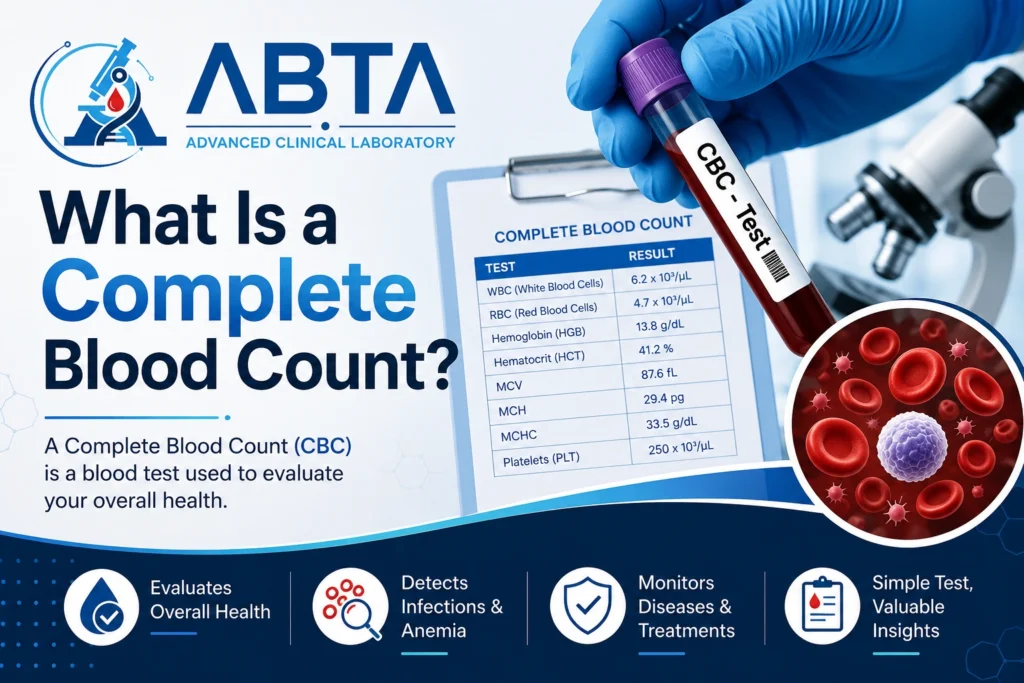
A blood test is one of the most common ways healthcare professionals evaluate a person’s general health. Among the many laboratory investigations available today, the Complete Blood Count (CBC) test is one of the most widely used hematology tests. A CBC provides information about different types of blood cells, including red blood cells, white blood cells and platelets. It may be requested during routine health checkups or when a healthcare professional needs more information about symptoms or an existing condition. At ABTA Clinical Laboratory in Titakudi, CBC is included among the hematology laboratory investigations offered as part of the laboratory’s diagnostic services. The laboratory’s listed services also include ESR, peripheral smear examination, reticulocyte count and coagulation profile testing. What Is a Complete Blood Count? A Complete Blood Count, commonly called a CBC test, is a blood investigation used to evaluate the number and characteristics of blood cells. The major components evaluated in a CBC include: Different laboratories may report additional parameters depending on the analyser and test configuration. Red blood cells are responsible for carrying oxygen throughout the body. White blood cells play an important role in the body’s immune response, while platelets are involved in normal blood clotting. Because these components perform different functions, examining them together can provide useful information for clinical evaluation. MedlinePlus describes CBC as a group of blood tests that measures the number and size of different blood cells. Why Is a CBC Test Done? A healthcare professional may recommend a CBC for several reasons. It may be included as part of a: CBC testing may help healthcare professionals investigate conditions involving blood cell counts, including anaemia, infections and certain blood or immune disorders. However, a CBC result should not be interpreted on its own. A healthcare professional may consider symptoms, medical history, physical examination and other laboratory investigations before reaching a conclusion. What Does a CBC Test Include? 1. Red Blood Cells Red blood cells contain haemoglobin and transport oxygen from the lungs to tissues. CBC-related red-cell measurements can provide information that may be useful when evaluating conditions such as anaemia. 2. Haemoglobin Haemoglobin is the oxygen-carrying protein found inside red blood cells. A healthcare professional may evaluate haemoglobin along with other CBC parameters when investigating symptoms such as tiredness or weakness. 3. White Blood Cells White blood cells are part of the body’s immune system. Changes in white blood cell counts can occur for many reasons, including infections and other medical conditions. Therefore, an abnormal value does not automatically identify a particular disease. 4. Platelets Platelets contribute to normal blood clotting. The platelet count is therefore an important part of many routine blood investigations. 5. Red Blood Cell Indices CBC reports may also include measurements describing the size and characteristics of red blood cells. These values can provide additional information when evaluating abnormalities in blood counts. CBC Test and Other Hematology Investigations At ABTA Clinical Laboratory, CBC is part of a broader hematology service. The listed hematology investigations include: Depending on the clinical situation, a doctor may recommend one or more of these tests. Is Fasting Required for a CBC Test? A CBC by itself usually does not require special preparation. However, if your healthcare professional has ordered additional blood tests at the same appointment, fasting may be required for some of those tests. Always follow the preparation instructions provided for your specific test package. How Is the Test Performed? A healthcare professional collects a blood sample, generally from a vein in the arm. The sample is then processed in the laboratory using appropriate laboratory procedures and equipment. The test itself is usually quick, although the time required for reporting can vary depending on the investigation and laboratory workflow. Why Choose a Professional Clinical Laboratory? The quality of laboratory testing depends on multiple stages, including sample collection, identification, processing, analysis and reporting. ABTA’s laboratory information describes a fully automated laboratory and highlights experience with advanced laboratory analysers and laboratory quality-control practices. For patients searching for a clinical laboratory in Titakudi, selecting a laboratory with appropriate diagnostic infrastructure and professional laboratory practices can be an important consideration. CBC Test in Titakudi If you are looking for a CBC test in Titakudi, ABTA Clinical Laboratory provides hematology investigations as part of its clinical diagnostic services. The laboratory is located at: ABTA Advanced Clinical Laboratory63, Perumulai Road, Titakudi,Cuddalore – 606106 For appointments, test availability and preparation instructions, contact the laboratory directly. Final Thoughts A Complete Blood Count is a fundamental laboratory investigation that provides information about important blood components. It is commonly used during routine health evaluations and when healthcare professionals need additional information about a patient’s health. If your doctor has recommended a CBC test, follow the laboratory’s preparation instructions and discuss the results with your healthcare professional rather than interpreting individual values without clinical context. ABTA Clinical Laboratory, Titakudi offers CBC and other hematology, biochemistry and diagnostic laboratory investigations as part of its laboratory services. Medical Disclaimer: This article is intended for general health information only. Laboratory results should be interpreted by a qualified healthcare professional in relation to your symptoms and medical history.